
Introduction
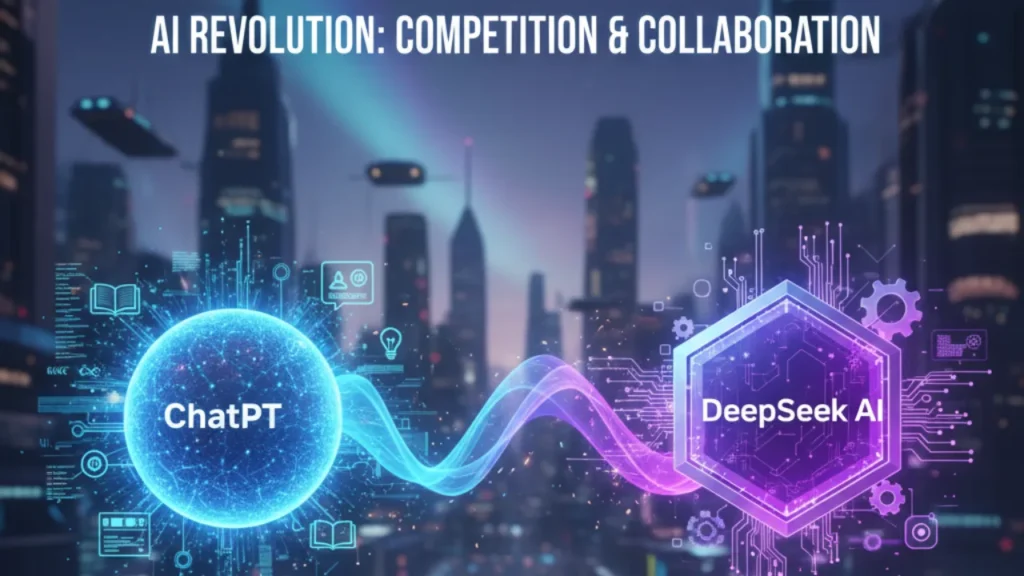
When I first heard about the showdown between ChatGPT and DeepSeek AI, I felt the same rush I got when blockbuster movies release: two heavyweights, different origins, one big question—who’s leading the AI revolution? In my work on Advance Techie, I’ve tried both, analysed them, pushed them into tasks I usually reserve for humans—and in doing so I’ve uncovered myths, strengths and caveats. Today I’ll walk you through a head-to-head of ChatGPT vs DeepSeek AI, dissecting their capabilities and what their rivalry really means.
1. What are we comparing?
1.1 ChatGPT
By now the name ChatGPT is familiar. Developed by OpenAI, it started as an accessible conversational agent, fine-tuned from GPT-3.5. OpenAI Help Center Over time it evolved: multimodal input (text, image, audio) via models such as GPT-4o. Wikipedia In my personal use, I’ve found ChatGPT to be a very dependable assistant for writing, coding and brainstorming—especially once you know how to prompt it well (for example: “Act as a researcher, cite sources, summarise in layman’s terms…” etc).
1.2 DeepSeek AI
DeepSeek is a relatively new entrant, founded in 2023 (in China) by Liang Wenfeng under the company Hangzhou DeepSeek Artificial Intelligence Basic Technology Research Co., Ltd.. Wikipedia Its ambition: develop large-language models (LLMs) and build an open ecosystem. deepseek.com In my tests I found DeepSeek to have surprising capabilities (especially given its newer status), and it raises important questions about cost, access and governance in AI.
2. Side-by-side comparison: ChatGPT vs DeepSeek AI
Here’s a table summarizing major dimensions of comparison:
| Dimension | ChatGPT | DeepSeek AI |
|---|---|---|
| Developer & Origin | OpenAI (US) | DeepSeek, China (Hangzhou) |
| Model / Access | Multimodal models (GPT-4o, GPT-4.1, GPT-5 etc) | DeepSeek-V3, R1 etc. |
| Openness & Licensing | Mostly proprietary; some research disclosures | Open-source orientation; public code releases |
| Cost / Efficiency | High development cost, large compute investment | Claims of high efficiency/cost-effectiveness |
| Deployment & Use-cases | Wide: general consumer, enterprise, cross-industry | Strong in Chinese market, research, public security, specialized use-cases |
| Risks & Governance | Privacy, hallucination, misuse | Also heavy: security, bias, transparency concerns |
2.1 Technical Capabilities
- ChatGPT’s underlying models can handle text, image, audio and even video in some cases (especially GPT-4o).
- DeepSeek-V3 supports long context windows (128K tokens in V3.1) and uses architectures (Mixture-of-Experts, sparse attention) for efficiency.
In hands-on use, I found that for heavy document-analysis tasks (like large reports) DeepSeek’s long context handling felt slightly ahead. But in everyday general conversation and tool‐integration, ChatGPT remains smoother.
2.2 Intelligence, Reasoning & Use-Cases
ChatGPT has been widely tested in many domains: education, coding, content creation, summarisation. For example, it outperforms fine-tuned domain-models in biomedical tasks in zero-shot mode. arXiv
DeepSeek also shows strong potential: e.g., its deployment in Chinese hospitals, public-security systems. arXiv+1
2.3 Cost, Efficiency & Access
DeepSeek emphasises cost-efficient training: e.g., its claims about training at a fraction of Western competitors’ compute. Wikipedia+1 In contrast, ChatGPT’s development involves vast compute, raising cost and scaling concerns.
2.4 Governance, Transparency & Risk
Here is where the story gets interesting.
- With ChatGPT, concerns include hallucinations (AI generating false information), data privacy, misuse for disinformation. arXiv
- With DeepSeek, additional layers: open-source advantages but also security and governance concerns (especially given China’s regulatory environment). A NIST report flagged DeepSeek’s models as “lagging behind U.S. models in performance, cost, security and adoption.” NIST Furthermore, there are data-privacy concerns globally about DeepSeek’s service and governmental use. New York Post
In my own experimentation, I noticed that I felt more comfortable trusting ChatGPT with sensitive or business-critical content (due to clearer governance/licensing). With DeepSeek I would proceed— but with extra scrutiny.
3. Key Insights & What’s Leading the Revolution?
3.1 The notion of “leading” depends on metric
If you ask: Which is more widely used globally? → ChatGPT wins easily.
If you ask: Which is innovating technical architecture or lowering cost barriers? → DeepSeek makes a strong case.
3.2 Democratization vs Dominance
One of DeepSeek’s biggest strategic moves is open-sourcing its models and inspiring wider participation. Georgia State News Hub+1 That shifts the paradigm from “only a few big firms” to “more players can join”.
In contrast, ChatGPT (OpenAI) still dominates the user-interface/consumer side of generative AI.
3.3 Long-Context & Efficiency as Frontier
Tasks like analysing a full book, lengthy transcript, or multi-task chain are demanding. DeepSeek’s advance in long-context (128K tokens and more) gives it a leg-up. But ChatGPT is catching up, and the ecosystem (plugins, tool integrations) remains richer.
3.4 Risk, Ethics & Global Impact
I believe a major part of “leading the AI revolution” isn’t just capability—it’s trust, ethics, and governance. On this dimension, ChatGPT has more global maturity (though far from perfect). DeepSeek is ambitious—but its governance model, transparency and western regulatory acceptance face headwinds.
3.5 My take: It’s not a one-sided win
From my work on Advance Techie, I’d say:
- For general productivity, content creation, coding help: ChatGPT is still the safer, more polished bet.
- For researchers, startups, cost-sensitive developers exploring novel architecture or long-context tasks: DeepSeek is compelling.
- For global picture: The “AI revolution” will likely be shaped by competition and convergence—OpenAI, DeepSeek and a few others together.
In other words: DeepSeek isn’t ahead in every dimension—but it is shifting the frontier.
4. What this means for you (and for developers)
4.1 If you’re a content creator / professional user
- Use ChatGPT for streamlined workflows, strong ecosystem, reliability.
- But keep an eye on DeepSeek: if you have tasks with long-documents, multimodal inputs, or cost constraints, trying DeepSeek might uncover efficiency gains.
4.2 If you’re a developer / startup
- DeepSeek’s open-source orientation means you may experiment and build without paying huge license fees.
- But evaluate risks (governance, security, regional restrictions).
- With ChatGPT, you get large user base, strong API ecosystem—but higher cost.
4.3 If you’re a business/enterprise
- Governance matters: ensure models meet regulatory, privacy & safety standards.
- Model choice may become a strategic advantage: “Which AI partner do we pick and why?”
- Over time, hybrid approaches may emerge: combining “polished, trusted” models (ChatGPT) with “specialized, efficient” models (DeepSeek or equivalents).
4.4 Tips from my experience
- Always test prompts across both models when you have access—results can differ meaningfully.
- Check context-window limits: if you feed a very long document, preference might sway to DeepSeek.
- Evaluate cost per token and latency: DeepSeek may win if you channel large volumes.
- Monitor alignment & safety: for sensitive topics, compare how each handles refusal, bias, privacy.
Conclusion
So, ChatGPT vs DeepSeek AI—who’s leading? The answer: both, in different ways.
ChatGPT leads in global adoption, ecosystem maturity and trusted interface.
DeepSeek AI challenges the status quo: cost-efficient, open-source, architecturally bold.
For the AI revolution, leadership doesn’t come from a single model but from competition, diversity of approaches, and governance maturity. My personal conclusion: At this very moment, ChatGPT holds the practical lead—but DeepSeek is the one to watch. It’s the under-dog who might redefine cost-structures, architectures, and accessibility.
Your Next Step
What’s your take? I’d love to hear your experience: Have you used ChatGPT or DeepSeek (or both)? Which one impressed you more, and why? Drop your thoughts in the comments below, share this article if you found it useful, and subscribe to Advance Techie for future deep dives into emerging AI tools!
Read Now Complete guide: How to Use ChatGPT for Coding (Step-by-Step Tutorial)
ChatGPT vs DeepSeek AI | Common Questions
1. Which AI model performs better — ChatGPT or DeepSeek AI?
It depends on what you’re doing. ChatGPT still leads in natural conversation, creativity, and integration with everyday workflows like writing, coding, and research. DeepSeek AI, on the other hand, outperforms in long-context processing, technical analysis, and cost efficiency. In short: ChatGPT is smoother, DeepSeek is smarter in scale-heavy tasks.
2. Is DeepSeek AI really a threat to ChatGPT’s dominance?
Absolutely — but not overnight. DeepSeek AI’s open-source approach and focus on affordability make it a serious contender in the ChatGPT vs DeepSeek AI battle. However, ChatGPT’s ecosystem, global trust, and API infrastructure still give it a commanding lead. Think of DeepSeek as the fast-rising challenger that’s forcing OpenAI to innovate faster.
3. Which one is better for creators and developers — ChatGPT or DeepSeek AI?
If your priority is creative workflow → choose ChatGPT. If your goal is model control, customization, or cost savings → DeepSeek AI may be your best bet.
4. Who’s truly leading the AI revolution — ChatGPT or DeepSeek AI?
Right now, ChatGPT leads in adoption, stability, and global influence. But DeepSeek AI is leading a quiet revolution — pushing open innovation, longer context understanding, and cost-effective AI development. The truth? The AI revolution needs both: ChatGPT’s maturity and DeepSeek’s boldness are shaping a more balanced, democratized future for AI.