
I still remember a late night call with a founder who had just crossed 50,000 users. On paper, it looked like success. The app was getting traction, tweets were rolling in, and signups kept climbing. But his voice told a different story. He was burning cash, struggling with churn, and personally answering support emails at 2 a.m.
His mistake was not execution. It was the decision he made in week one without realizing its long term weight. B2B B2C SaaS is not just a market choice. It is a commitment to an entirely different business life.
Most founders think this decision is about audience size or pricing. In reality, it affects how you build, sell, support, market and even how stressed you feel on a daily basis. I have worked with both models, tested products in each and advised teams that switched sides halfway through. The painful lessons almost always arrive late.
This article is not a comparison checklist. It is a reality check drawn from experience, failed assumptions, and patterns that repeat more often than founders admit.
The Decision That Quietly Defines Your Entire Company
When founders say, “We will start B2C and later move into B2B,” I usually pause. Not because it is impossible, but because it rarely happens smoothly.
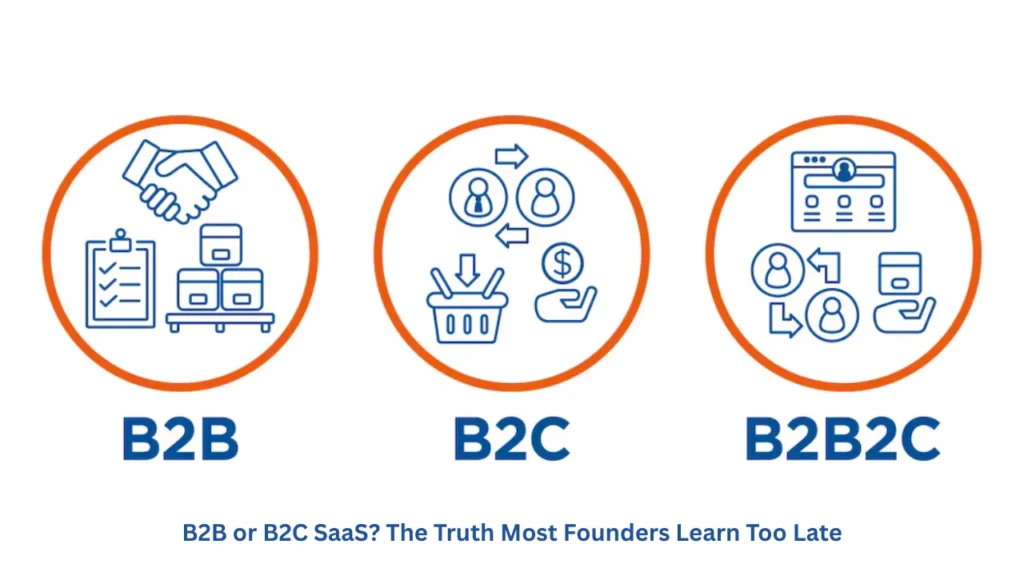
In B2C SaaS, everything optimizes around volume. You chase frictionless onboarding, viral loops, emotional hooks and mass distribution. In B2B SaaS, everything revolves around trust, workflows, stakeholders and measurable outcomes.
I once helped a B2C productivity app add “team features” to attract companies. The code was easy. The mindset shift was brutal. Suddenly, one buyer became five decision makers. Security questions appeared. Legal reviews slowed deals. Support tickets turned from casual messages into urgent operational blockers.
The founder told me later that he underestimated how deeply the B2B B2C SaaS choice shapes your product DNA.
Revenue Looks Similar Until You Zoom In
At a surface level, both models sell subscriptions. Monthly recurring revenue looks the same in dashboards. This is where many founders get confused.
In B2C SaaS, I have seen products with tens of thousands of paying users still struggle to hire properly. Churn is relentless. Marketing never sleeps. One algorithm change or trend shift can wipe out months of growth.
In B2B SaaS, I have seen companies with fewer than 200 customers generate calmer and more predictable revenue. Deals take longer, but once embedded into a business workflow, customers rarely leave without serious reason.
Here is something that surprised me early on. In B2C, growth hides problems. In B2B, growth exposes them.
A B2C product can survive with mediocre onboarding if marketing keeps filling the funnel. A B2B product cannot. Every missing feature, unclear permission system, or reporting gap shows up during sales calls and renewals.
Customer Psychology Is Where Most Miscalculations Happen
B2C users buy with emotion and habit. They cancel without guilt. They rarely complain before leaving. You learn through analytics, not conversations.
B2B customers buy with fear and responsibility. Fear of making the wrong tool choice. Responsibility toward their team, data, and leadership. When something breaks, they tell you immediately.
In one B2B B2C SaaS comparison I ran internally, we noticed something striking. B2C feedback came in the form of app store reviews. B2B feedback came as long emails, calls, and shared documents.
This difference changes how you build features. B2C SaaS rewards intuition and fast iteration. B2B SaaS rewards listening, documentation, and deliberate planning.
Neither is easier. They are simply difficult in different ways.
Marketing Feels Easier in B2C Until It Stops Working
Many founders choose B2C because marketing looks fun. Social media. Influencers. Viral growth. I have done it. It works until it does not.
I once ran paid ads for a B2C SaaS tool where customer acquisition cost slowly crept up every month. Features did not change. Ads did not change. Competition did.
In B2B, marketing feels slower but compounds. A single in depth article, webinar, or case study can generate leads for years. That is why content heavy strategies matter more in B2B SaaS.
If you want a deeper look at how search driven growth plays out here, this connects well with SEO Strategies for SaaS Companies.
The hidden cost of B2C marketing is emotional fatigue. You are always chasing attention. In B2B, you chase relevance.
Support Is Not a Cost Center. It Is a Signal
One of the most overlooked differences in B2B B2C SaaS is support.
In B2C, support volume grows with users. You automate aggressively or drown. Many B2C founders silently resent support because it does not scale cleanly.
In B2B, support is part of retention. I have personally seen enterprise renewals saved because support responded thoughtfully to one frustrated operations manager.
A small case study worth mentioning. A B2B analytics tool I consulted for added a dedicated Slack channel for key customers. Support load increased. Churn dropped significantly. Revenue stabilized.
That approach would be financially dangerous in B2C. In B2B, it became a growth lever.
Pricing Reality Most Founders Ignore
B2C pricing lives in psychological thresholds. One dollar more can cut conversions in half. Discounts matter. Annual plans need persuasion.
B2B pricing lives in value justification. If your tool saves ten hours per employee per month, pricing conversations change entirely.
Here is an unexpected lesson. B2B customers complain more about underpricing than overpricing. Low prices signal risk. High prices demand confidence.
This is why pricing pages feel so different across B2B B2C SaaS products. One sells emotion and simplicity. The other sells outcomes and proof.
If pricing strategy fascinates you, the mindset shift is similar to what I explained in What Is B2B SaaS and Why It Matters.
The Switching Trap Nobody Warns You About
Founders often say, “We will validate with consumers, then sell to businesses.”
I have rarely seen this work without major rebuilding.
Data models change. Feature priorities flip. Roadmaps collapse. Teams lose focus.
I worked with a startup that pivoted from B2C to B2B after two years. They underestimated compliance requirements, onboarding friction and sales cycles. It felt like starting over with less energy.
Switching from B2B to B2C is equally painful. Products become too complex. Pricing feels intimidating. Marketing lacks emotional appeal.
The truth is simple but uncomfortable. Choose early and commit deeply.
Reality Check Comparison
| Area | B2C SaaS Reality | B2B SaaS Reality |
|---|---|---|
| Growth | Fast but fragile | Slow but compounding |
| Churn | High and silent | Lower but vocal |
| Marketing | Attention driven | Trust driven |
| Support | Cost center | Retention lever |
| Pricing | Emotion based | Value based |
Research That Matches Real Experience
OpenView Partners’ SaaS benchmarks consistently show lower churn and higher lifetime value in B2B compared to B2C. This aligns perfectly with what I have seen in real products.
Stripe’s subscription economy reports also highlight how B2B SaaS businesses benefit from predictable billing cycles and expansion revenue.
These are not theories. They match what happens after the excitement fades.
So Which Should You Choose?
The honest answer is not based on market size. It is based on how you want to work.
If you enjoy storytelling, distribution, and rapid experimentation, B2C may fit you. Expect volatility and constant iteration.
If you enjoy solving deep operational problems, building relationships, and playing long games, B2B may suit you better. Expect slower starts and heavier responsibility.
In B2B B2C SaaS, the wrong choice does not kill you immediately. It drains you quietly.
Final Thoughts From Experience
Most founders do not fail because of bad ideas. They fail because they picked a model that fought their strengths.
Before you decide, talk to founders who survived three years in that model. Not just the success stories. Ask about stress, churn, and regrets.
And if you are already deep into one path, double down instead of fantasizing about the other.
If this article resonated, explore B2B SaaS SEO Challenges. I would also love to hear your experience. Drop a comment and tell me which side you chose and why.
FAQs: B2B or B2C SaaS
Which is more lucrative: B2B SaaS or B2C SaaS?
From my experience, B2B SaaS tends to get profitable quicker than consumer SaaS—mainly due to higher lifetime value and lower churn.
Is B2C SaaS better to build for first-time founders?
It feels easier at the start because onboarding and selling are simpler, but sustaining growth becomes harder as you scale.
Is it possible to target both B2B and B2C users with one product?
It’s possible, but it generally results in a watered-down product unless you have the teams very clearly separated.
Which model is the most effective for bootstrapping?
B2B SaaS is better for bootstrapping because you need fewer customers to generate meaningful revenue.
Is marketing more important than product when it comes to B2C SaaS?
In my experience, yes. In B2C, distribution often matters as much—or more—than feature development.
Is it worth transitioning from B2C to B2B SaaS?
Only if you’re willing to rebuild parts of your product and your mindset. It’s not a small pivot.